
 Strattons of Massachusetts Bay
Running Through the Sands of Time
Samuel William Patton Sr. (1909–1989)
Samuel William Patton Sr. — Uncle Sam to me — was my uncle by marriage, a career Indiana State Trooper, and for five years in the 1940s the closest thing my sister Marilu had to a father. He was also one of the original eighteen men of Indiana State Police Post 2 in Ligonier. His story and Ligonier’s are hard to tell apart, so I am going to tell them together.
In the early 1930s, Ligonier, Indiana, was not a town with a police department in any modern sense. What it had was an appointed Town Marshal — a one-man office, sometimes assisted by a part-time Deputy Marshal or a constable — all of them closer in practice to the volunteer fire department than to any professional force. The firemen were neighbors who dropped what they were doing when the bell rang, working with whatever equipment they could build or scrounge. The marshals were much the same. If something serious happened in or around Ligonier in those years, there was nobody in town trained and equipped to handle it.
That was the problem the Indiana State Police had been organized, in 1933, to solve. Prohibition and the Depression had produced a generation of Public Enemy criminals who moved across county and state lines faster than a local sheriff could follow. The ISP’s job was to catch them. The first troopers patrolled on motorcycles. By 1935 the force was expanding into regional posts, and Ligonier was chosen as the headquarters for Post 2.
Post 2 opened in September 1935 with eighteen men assigned — officers, detectives, and the support staff to keep the operation running. For a town Ligonier’s size, eighteen full-time professional lawmen dropping into the middle of town was a transformation. For the first time, the city had a real law-enforcement presence, and for the next eight years the state troopers were in effect its police department.
The post operated out of existing structures on the town triangle where South Cavin Street merges into SR 5 — Lincoln Way South — uptown from the main business district. The radio system was new and, at first, one-way: the post could broadcast to the cars on patrol, but the troopers on the road could not talk back. Within a few years the cars themselves caught up with the ambition of the force. Post 2 was issued 1936 Cords — the “coffin-nose” front-wheel-drive beauties built down the road in Auburn, Indiana. Advanced for their time, temperamental for a driver, and fast enough to run down the cross-state gangsters the ISP had been organized in part to stop. We kids on the block watched them come and go as if they had dropped in from the future.
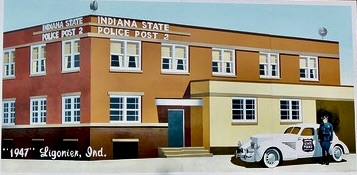
The original quarters on the triangle were never meant to be permanent. In 1943 the post moved about a half mile north on SR 5 to a purpose-built brick barracks and garage across from Oak Park Cemetery. Contractor Harry Bunger of Cromwell scrounged materials through the wartime shortages to get it built. From there Post 2 would cover seven counties for nearly forty more years.
Four of the original Post 2 men lived on that same block with their families: Uncle Sam, Trooper Milton Hull, radio operator Fritz Leeson (Schultz on the records), and Trooper Paul Beaverforden. I lived just north of the barracks on Cavin Street, which is why those four are as fixed in my memory as any relative. Milton Hull’s son Tom was a friend. It was an “ISP family” block in every sense, and what we knew of state-police work we knew firsthand, not from the newspaper.
There was one more small-town thread in that knot. Mrs. Beaverforden — Paul’s wife Hannah — was my fifth-grade teacher in 1948, and my favorite. One of the four troopers on my block was married to the teacher I liked most in all of grade school. That is the kind of thing that only happens in a small town, where the law, the schools, the neighbors, and your own family all draw from the same short list of names. In Ligonier in the 1940s, everyone you knew showed up more than once.
“A good man in a uniform is worth ten without one.”
Samuel William Patton was born on June 29, 1909, in Noble County, Indiana. He graduated from Ligonier High School in 1927, and I have his portrait from the 1924 yearbook — a serious-faced boy in a collar and tie, already looking as if he meant business. When the State Police opened its academy six years later, Sam went. Family memory has it that he was in the very first graduating class, or very close to it. Whatever the exact cohort, he came in at the beginning of the story and stayed a trooper for the rest of his working life. He drew the assignment closest to home, and Post 2 got him from the day it opened.
“A bloodhound doesn’t know the word ‘quit.’”
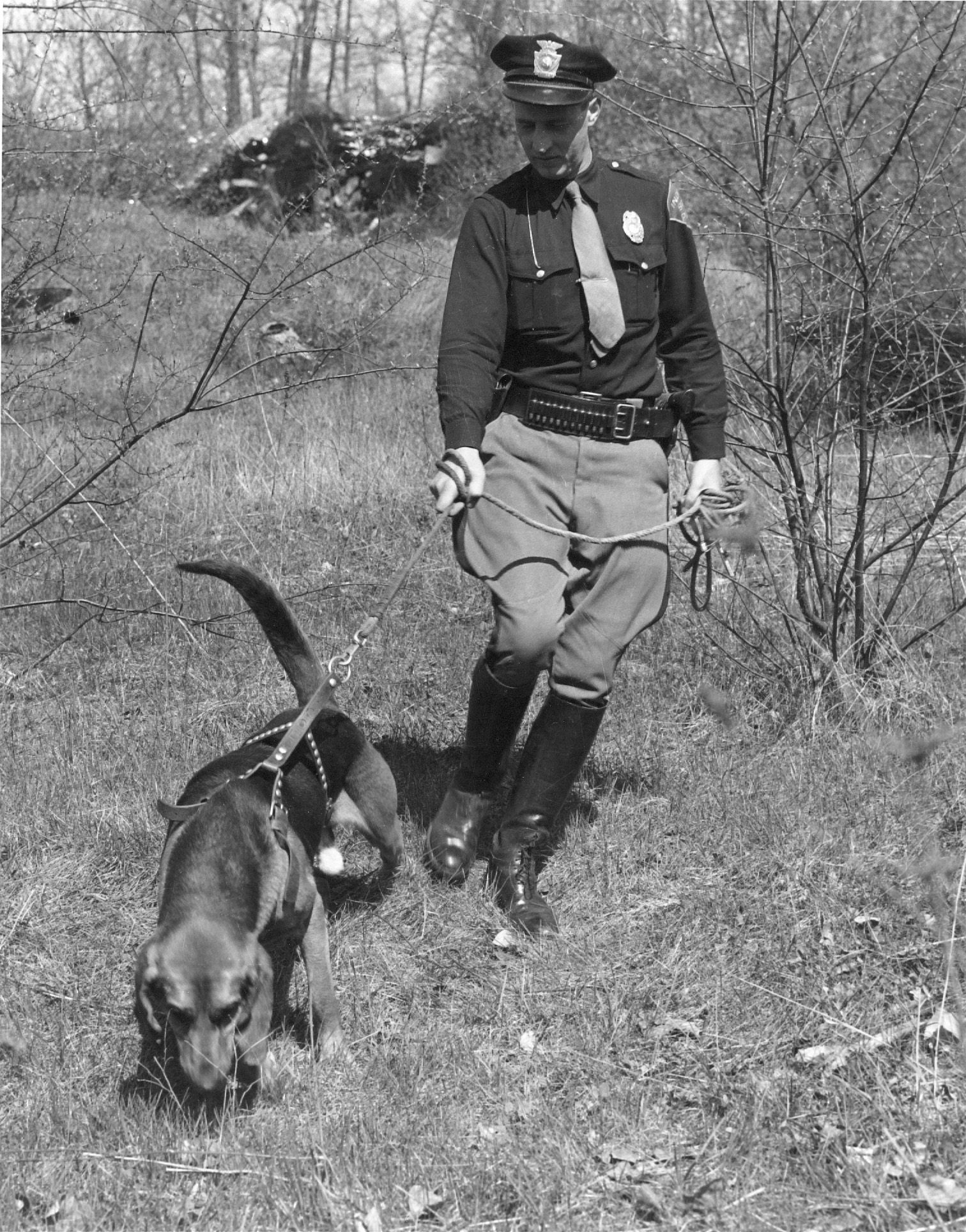
Sometime in the late thirties or early forties, the Indiana State Police began experimenting with tracking dogs. Uncle Sam was assigned a bloodhound named Brutus, and for a stretch of years the two of them worked as a team. In an age before helicopters and computer databases, a trained dog’s nose could mean the difference between finding a lost child before nightfall and not finding the child at all.
What I know about Uncle Sam and Brutus comes mostly from family stories rather than my own eyes: Sam getting rousted out of bed at an odd hour, pulling on his uniform while Brutus leaned into the leash, the pair of them heading down a farm lane or along a creek bank to follow whatever trouble had broken loose that night. Neighbors would watch the trooper and his dog disappear into the dark and take comfort from the sight.
The rest of the job was whatever the road brought him: crash scenes, stranded motorists, speeders and drunks, and, now and then, the knock on a farmhouse door in the middle of the night with news nobody wanted to hear. If those things weighed on him, he did not bring them home in any way the rest of us could see. He did his shift and then came back to Aunt Mary’s kitchen.
Uncle Sam loved trains. He also had a reputation around the post as a notoriously bad driver — the other officers would not let him take the Cord out unless there was no one else available. The two facts came together the day he eased his patrol car up close to the tracks at an intersection in Ligonier to watch a train pass. Sometimes, he said, he wanted to feel the rumble and the noise; sometimes the lay of the spot did not give him much choice. A rear wheel dropped against the rail and wedged there. The results were spectacular. Sam heard about that one for years — and not only from his fellow troopers. The whole family carried the story forward with him, and any lingering doubt about his standing as the worst driver on the roster was settled for good.
Even after automatic transmissions came in, Sam never adapted. He always pulled away in his cruiser in second gear — a little more gas, a little more clutch slip than anyone else needed — and then shifted once more into third and drove on. It got him where he was going, and that was the extent of his relationship with a gearbox.
“The heart knows its own.”
In 1937 Sam married my mother’s youngest sister, Mary Gertrude King. Aunt Mary was twenty-three, Sam was twenty-eight. She had been born on March 8, 1914, in Whitley County, the fourth and last daughter of my grandparents Volney William King and Bertha McConnell King. Her older sisters were my mother Lucille (1902), Aunt Evelyn (1905), and Aunt Lou (1910). Mary was the baby of the King girls, and I believe Sam understood that from the start. He treated her gently and steadily for the thirty-five years they had together. Their first son, Samuel William Patton Jr. — “Sam Jr.” to all of us — was born in 1940. Their second son, Ronald Allen “Ron” Patton, arrived on May 27, 1942. With the two boys, the Pattons made one of the steadiest households in our extended family, anchored there in Ligonier.
Around the house Sam was more domestic than his uniform suggested. He was proficient with an electric mangle and would iron anything the laundry threw at him — shirts, sheets, whatever came through the wash. He and Aunt Mary rarely missed a Christmas party at my parents’ house, and when they came they usually brought along Sam’s sister Kathryn and her husband “Bunt” Reed. By then Aunt Mary was after Sam about his pipe-smoking, but he had too many years of pipe in him to stop, and every so often he would slip across town to my parents’ house for a quiet puff or a bottle of beer when the pressure at home got close. He was a super uncle.
The boys supplied their own kind of ambient chaos. Sam Jr. and Ron once painted neighbor Louis Levy’s black Cadillac white. Levy was the wealthiest man in Ligonier, and possibly in the county. The story does not improve on retelling; it was already as good as a story gets.
“A home is the people in it, not the walls.”
For the better part of five years, Aunt Mary and Uncle Sam were my sister Marilu’s parents in everything but name. Her father, Doc Stratton, had been dead since October 1940. Her mother had remarried into a violent household and stayed there. Mary and Sam were what was left.
Marilu first came to them around the midpoint of her seventh-grade year — early 1946, by my best recollection — and stayed through the end of her junior year at Ligonier High School in June 1951. By then I had come off the farm and was living with Mom, Jake, and Grandma Bertha at 902 South Cavin Street in Ligonier. I was in third grade, Marilu in seventh, and partway into that school year it became clear she needed a better landing place than ours. That following fall, she left for Arizona to finish her senior year at Scottsdale High School, graduating in June 1952.
My mother was not blameless in any of this, and I will not pretend otherwise. Lucille’s third marriage — to Jake Hunter — had grown unstable and was sliding toward the violence that would define their later years together. She knew the man she was married to, and she stayed anyway. A woman who keeps her marriage while her children find homes at her sister’s is a woman who has made her choice.
Aunt Mary and Uncle Sam, with Sam Jr. and Ron already in the house, simply took Marilu in — without announcement and without fuss. A state trooper’s salary did not stretch very far in the 1940s, and Aunt Mary was already raising two small boys, but they made a home for her that our own had stopped being. My mother herself, later, put it plainly: the Patton household was the safe harbor, and ours was slowly sinking. That single sentence says more about Sam and Mary than any list of jobs or accomplishments could.
When Uncle Sam left the Indiana State Police, he did not drift into retirement. He went to work for the American State Bank of Ligonier, which trusted him to carry cash — the physical movement of money between branches and on errands in the years before armored cars and electronic transfers were common in a town our size. It was the sort of work that demanded a man the bank directors and the community trusted without having to think much about it, and Uncle Sam’s years on the road fit that description exactly. He drove familiar routes with unfamiliar cargo. Even out of uniform, he carried himself the way a trooper carries himself. And he brought the satchels home.
I am still tracking down the exact years he worked at the bank and will tighten this part of his story when I have the dates in hand.
In his later years Sam also served on the Ligonier Board of Zoning Appeals, and he was a member of the Ligonier Elks. His public life kept pace with his private one all the way through.
The most infamous story in the family is Uncle Sam’s kitchen remodel. It started around the time he retired from the ISP — maybe a little before — and it started with the tear-out. Then it sat. For at least ten years. I think the roof got patched somewhere in there, and the basement may have gotten a redo, but the kitchen itself stayed torn out. The whole operation came down to a plug-in electric burner on a small table in the hallway outside the kitchen, in the entryway through the back door. Aunt Mary, working out of that, still managed to produce some world-class mac and cheese.
There was another side of Uncle Sam that the grandchildren talk about as much as they talk about the trooper years. He was a legendary picker at the local dump run by “Allie” Alfrey outside Ligonier. Other people threw things away; Uncle Sam looked at what they were throwing away and, now and then, brought something back. A chair that needed new glue, a trunk with good hardware, a clock that might tick again with a little coaxing — he saw possibilities where others saw junk. It was not hoarding, and it was not exactly a hobby. It was an eye for what still had value.
Refinishing was part of the same instinct. He was quite proficient at it, using lye water to strip the old finish before he brought the wood back. Whether a piece came from Alfrey’s or arrived some other way, the goal was always to see what the thing could be, not what it currently was. In that way, the dump runs matched his other working lives: where most people saw risk, waste, or something used up, Uncle Sam looked for what was still worth saving.
Uncle Sam liked to say that his favorite pie was hot pie and cold pie — in other words, any pie you set in front of him. For years he made an annual trip to the Indianapolis 500 as a volunteer security guard, and on at least one of those trips he arranged for some of my cousins to help out and get in free. Another time he pulled a similar trick at an Abbott and Costello show in Fort Wayne, working it out so that he and a handful of the cousins got in on the strength of his security badge. I was not one of the lucky ones on the free-admission days, but cousin Jim Biddle later told me both stories and either said or strongly implied that he was among the cousins who got in. The stories are true; the finer details may have blurred with time.
According to Cousin Jim, he got Indy 500 trips with Uncle Sam more than once. On those occasions he slept at the Indiana State Police headquarters at Stout Field in Indianapolis when Sam was off duty, and in the back of his patrol car when he was on.
One more worth keeping is the ice-fishing spud. One winter day he was working a spud to open a hole through the ice when it slipped and sliced neatly through the leather of his boot and the sole of his shoe — right between his big toe and the next — without touching flesh. He took as much kidding over that near-miss as he did over the train.
Post 2 broadcast its final radio transmission at 8:00 a.m. on May 27, 1982, after which the barracks was torn down. A McDonald’s stands on the lot today. The history of Post 2 is commemorated by a 2011 mural on the back wall of the current Ligonier Police Department at 301 S. Cavin Street, depicting Paul Beaverforden beside a 1936 Cord. Uncle Sam’s name carries forward in that history, listed alongside Milton Hull and Fritz Schultz as one of the men who made Post 2 what it was.
Uncle Sam died on September 16, 1989, and was buried three days later in Ligonier.
Samuel William Patton Sr. (1909–1989) married my mother Lucille’s youngest sister, Mary Gertrude King (1914–1972), in 1937. He spent his working life first as a career Indiana State Trooper — one of the original eighteen men of Post 2 in Ligonier, and a bloodhound handler paired for years with his dog Brutus — and later as a trusted cash courier for the American State Bank of Ligonier. He lived his life in and around Ligonier, Noble County, Indiana. He and Aunt Mary raised two sons, Sam Jr. and Ronald, and, during the worst years of my own childhood, they gave my sister Marilu a home. Uncle Sam is buried in Ligonier.
 —Wm. F. Stratton, April 2026