About This Site
Over 50 years of research into the Stratton, Schneider, King, and allied families—from colonial Massachusetts to Indiana and beyond. Built by Bill & Karen Stratton.

 Strattons of Massachusetts Bay
Running Through the Sands of Time
Farmer, Soldier, Grandfather (1876–1966)
"The greatest delight which the fields and woods minister is the suggestion of an occult relation between man and the vegetable." —Ralph Waldo Emerson
Volney William King was born on January 5, 1876, in Eden Township, LaGrange County, Indiana, the son of Isaac William King and Christiana Lena Gerber. His father was the same Isaac King who had marched with the 88th Indiana Infantry through Perryville, Stones River, Chickamauga, Missionary Ridge, and Sherman's March to the Sea—the man whose story is told elsewhere on this site—and who had come home to Perry Township with a crooked scar on his foot and nothing to say about the war except that they did what had to be done.
Volney grew up on the King family land near the Haw Patch in Perry Township, Noble County, a fertile stretch of gentle rolling ground named for the hawthorn trees that lined its hedgerows. The 1880 census finds him there at age four, a small boy in a household of working farmers. His education ended at the eighth grade—common enough for a farm boy in that era, when hands were needed in the fields more than in the schoolhouse—but what he lacked in formal schooling he made up for in the kind of knowledge that keeps a farm running: when to plant, when to cut, how to read the weather, how to fix what breaks.
"War is the continuation of politics by other means." —Carl von Clausewitz
In 1898, when war broke out with Spain over Cuba, Volney was twenty-two years old and strong enough to go. He enlisted in the infantry and served as a corporal, shipping out to Florida where American troops were staging for the campaign in Cuba and the Caribbean. The war itself was short—over in a matter of months—but the camps in Florida were a different kind of battlefield. Malaria swept through the staging areas, carried by mosquitoes that bred in the swamps and standing water around the encampments, killing and disabling more soldiers than Spanish bullets ever did.
Volney picked up malaria for his war effort. He came home alive, but the fever would return throughout his life—the invisible souvenir that so many Spanish-American War veterans carried back to Indiana farms and Michigan factories and Ohio shops, a debt the government would eventually acknowledge through the VA system that became, decades later, his final home.
"Marriage is the highest estate, and requires and should receive the best cultivation of the heart." —William Gilmore Simms
On September 27, 1900, Volney married Bertha Lena McConnell in Columbia City, Whitley County, Indiana. Bertha had been born on November 25, 1878, in Leipsic, Putnam County, Ohio, the daughter of the McConnell family whose reunions at Round Lake would become a fixture of the extended family's life for generations.
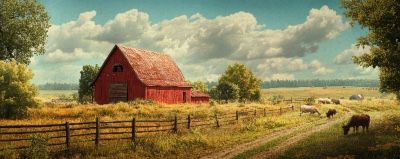
They settled on what came to be known as the Brush College Farm—eighty acres that had originally belonged to Volney's parents, located about a mile and a half southeast of Ligonier. The farm abutted US Highway 6 on the north and Diamond Lake Road on the south; a rural gravel road, West 750, defined the western boundary, and the Longnecker farm made up the east. The address was simply King, RR2, Ligonier, Indiana, and the phone number on their party line was two longs and a short.
Their first children, twins—a boy and a girl—were born on July 28, 1901. Neither survived. One died the same day; the other survived only eleven days. They were buried in Sparta Cemetery as Boy King and Girl King, never christened. It was the kind of loss that sat on a family whether anyone spoke of it or not.
But children kept coming. Lucille Dee arrived on July 29, 1902—the first one they got to keep. Then Evelyn Lillian in 1905, Louisa Christina in 1910, Clayton Volney in 1912, Mary Gertrude in 1914, and finally Isaac William—named for Volney's father, the Civil War veteran—in 1915. The farm turned into a crowded, noisy household where everybody's hands were needed.
"The glory of gardening: hands in the dirt, head in the sun, heart with nature. To nurture a garden is to feed not just the body, but the soul." —Alfred Austin
Volney farmed with two Belgian horses named Betsy and Topsy—a mare and a gelding, dark bay with white blazes on their faces and manes. He kept six milk cows, three Jerseys and three Guernseys, named after his children. He raised hogs, kept chickens, tended an orchard of apple trees, and grew the crops that kept the operation going.
The one thing everyone remembered about Volney was that you always knew where to find him: he was always working. In the fields plowing or planting or mowing. Fixing fences, repairing buildings, mending harnesses. In the barn milking, feeding cows and pigs, or sharpening tools. On the rare days when weather kept him out of the fields, he could be found at the kitchen table with a jigsaw puzzle or a crossword from the Fort Wayne Journal Gazette.
He didn't talk much. But when he did, you listened.
"Family is not an important thing. It's everything." —Michael J. Fox
Volney was not a man who let things slide when family was involved. When his eldest daughter Lucille eloped at sixteen with her schoolteacher, Fred Hendrickson—both lying about their ages to get a marriage license in Michigan—Volney fought the union from the start. He viewed it as illegal and improper: his underage daughter married to a man eight years her senior on the strength of falsified documents. He did not let it go. On January 18, 1932, more than thirteen years after the elopement, he finally succeeded in pushing a divorce through the courts.
When Lucille later married Dr. Frederick Nelson Stratton—Doc, as everyone called him—Volney and Bertha adored their new son-in-law. A dentist who practiced in Ligonier, a veteran, a man from a family of respected standing. After the disaster of the Hendrickson marriage, here was someone they could proudly claim. Doc and Lucille stayed at the farm during the week, and on weekends they would take everyone to the cottage at Tippecanoe Lake. For a few years the family had something like peace.
But Doc died in 1940 of Banti's Syndrome, leaving Lucille a widow with three children. When she remarried quickly—to Jake, a carpenter with a serious drinking problem—Volney stepped in again. He took his three-year-old grandson Billy back to the farm to live with him and Bertha. On the surface it might have looked like helping out. Underneath, it was Volney doing what Volney always did: protecting his own.
"In every conceivable manner, the family is link to our past, bridge to our future, and the context for our present." —Alex Haley
From about 1941 to 1946, I lived with Grandpa and Grandma on the Brush College Farm, and those years are the ones I carry closest. Grandpa showed me the Indian burial mound in the woods—the farm, it turned out, had been a significant site for Native American gatherings, with the Elkhart River running along the north end. Indiana University would later excavate the entire property in the 1960s and add thousands of relics to their collection. But to me it was just the place where cousins and I found arrowheads and stone axeheads in the plowed fields.
I followed Grandpa everywhere. In the fields, sometimes riding on the horse-drawn wagon. Watching him plow, mow, or plant. I'd carry his lunch and an earthen jug of cold well water out to whichever field he was working, and he'd eat in the shade of the big hickory trees along one edge of the largest field. Those same trees supplied Grandma's kitchen with the savory hickory nuts she used in her baking.
Grandpa was a hunter, and I went with him often enough to think I knew how it worked. He shot ducks, doves, pheasants—always birds, always from the sky. So one day when he stopped, shouldered his 20-gauge, and fired, I immediately looked up. Nothing. Grandpa never missed, so I was baffled. And then he broke out laughing—something he almost never did, and certainly not like this. When the laughter stopped, he walked over and picked up a dead rabbit. From then on, he told that story to anyone who stood still long enough. The punch line was always the same: “Billy thinks rabbits can fly.”
Discipline was simple and direct. One or two swats across the rear with a hickory stick—the bigger the kid, the bigger the stick. I learned something from those whippings: don't lie. Unless he doesn't know you're lying, and he almost always knew.
"For the farmer, the seasons turn and the years circle back; and it is a different thing each time." —Wendell Berry
The farm ran on seasonal rhythms that organized the whole year. When it was time to make apple butter, the neighbors would bring their apples and their copper kettles. Fires were built for each kettle, the apples pared and chunked the night before. Into the kettles they went, mashed with a huge wooden tool that looked like a giant potato masher. Sugar, spices, cider, and apple cider vinegar were added in quantities that each kettle master guarded like a secret. Grandpa used the apple grinder on the cider press to break down the bigger chunks. Eight or nine hours later, dark brown goodness came out of those kettles and went straight onto fresh bread from the oven.
Slaughter day in the fall was another event burned into memory. Grandpa would bring a hog into the barn and shoot it with a .22 rifle, then slit its throat. He would drink some of the fresh blood from his tin cup—a practice I never fully understood, though I later learned my own father had drunk fresh animal blood when he was anemic and dying. We made sausage using the intestinal walls for casing, and rendered the lard from the skin to make cracklings—and I couldn't believe how good rendered pig skin could taste.
"The course of life is like the sea; do we advance and prosper, a thousand fresh floes from which we may choose our direction." —Ralph Waldo Emerson
One day in January 1946, Grandpa left the farm. Grandma was with him, and Uncle Ike drove the black 1937 Chevy sedan. Grandpa never came back.
I was eight years old, and nobody could explain it in a way that made sense to me. What I learned later was that Volney's health had been breaking down for some time—hardening of the arteries, they called it, which caused changes in his personality and memory that Bertha could no longer manage at home. He was admitted to the Veterans Hospital in Marion, Indiana, into a locked ward, and there he would spend the remaining twenty years of his life.
With Grandpa gone, Bertha couldn't run the farm alone. She and I moved in with my mother and Jake in Ligonier—a catastrophic arrangement that traded the quiet safety of the farm for the chaos and violence of a household ruled by a drunk. Those years, 1946 to 1949, were the worst of my childhood.
"We forget all too soon the things we thought we could never forget." —Joan Didion
I visited Grandpa only once, when I was eleven, just before I left for Arizona. Grandma decided it was time, though I suspect she needed company more than she thought I needed to see him. The drive to Marion felt endless, and the hospital itself was institutional and cold—long hallways with worn linoleum, the smell of disinfectant barely masking the odors beneath.
The man in the chair was not my grandfather. He was smaller than I remembered, diminished in every way. His eyes moved but didn't land on anything. Grandma leaned down and kissed his cheek.
“Hello, Vol,” she said softly. “I brought Billy to see you. You remember Billy.”
He looked at me without recognition, then turned to the window and began muttering about a baseball game that wasn't happening. A play-by-play of phantom innings, batters and pitchers who existed only in whatever was left of his mind.
“Do you remember when we went fishing?” I tried. “You taught me how to bait a hook.”
Grandma's eyes glistened. “He remembers,” she whispered. “I know he does. He's just having a bad day.”
On the drive home, she talked about how good he'd looked, how clean and well-fed. She convinced herself the visit had meant something, that somewhere deep inside he'd known we were there. I nodded and agreed because what else could I do?
"The dead cannot cry out for justice; it is a duty of the living to do so for them." —Lois McMaster Bujold
Volney William King died on October 16, 1966, at the VA Hospital in Marion, Grant County, Indiana. The cause of death was listed as bronchopneumonia, with arteriosclerosis and depressive psychosis as contributing factors. He was ninety years old. He had spent the last twenty years of his life in that locked ward—longer than many of the years he'd spent free on the farm.
Two days later, on October 18, they buried him at Sparta Cemetery in Kimmell, Noble County, not far from the land his father Isaac had farmed after coming home from the Civil War, not far from the Brush College Farm where he'd raised his family and where a small boy had once carried a jug of cold water out to the hickory trees.
Bertha outlived him by six years, dying of a stroke on January 17, 1972, in Ligonier, at the age of ninety-three. She was laid beside him at Sparta.
When my mother Lucille died in 2000, we took her back to Sparta Cemetery too, and buried her next to Volney and Bertha and all the rest of the Kings. She'd spent her whole life leaving Indiana. In the end, that's where she came back to.
"The most important thing is that we leave something behind to remind people of us." —Cormac McCarthy
I think about Grandpa most when I'm working with my hands or standing outside early in the morning when the air is still cool and the day hasn't started yet. He was not a man of words. He didn't give speeches or write letters or leave behind any philosophy you could put in a frame. What he left was simpler and harder to name: the knowledge that work is how you hold the world together, that you protect the people who need protecting, and that sometimes love looks like a man in overalls walking to the barn at dawn because the cows won't wait.
He showed me where to find arrowheads. He taught me that rabbits don't fly. He gave me five years of safety when the rest of my world was falling apart. That was enough. That was everything.
Volney William King (1876–1966) was the son of Isaac William King and Christiana Lena Gerber of Perry Township, Noble County, Indiana. He married Bertha Lena McConnell on September 27, 1900, in Columbia City, Indiana. They raised six children to adulthood on the Brush College Farm near Ligonier. He served as a corporal in the infantry during the Spanish-American War and is buried at Sparta Cemetery, Kimmell, Noble County.
 —Wm. F. Stratton, April 2026
Over 50 years of research into the Stratton, Schneider, King, and allied families—from colonial Massachusetts to Indiana and beyond. Built by Bill & Karen Stratton.
If you are tracing a Stratton line, start here. Harriet Russell Stratton's two-volume Book of Strattons is the most comprehensive Stratton genealogy ever compiled—both volumes are free and fully searchable online.